One Person, the Work of a Hundred
By Salim Jernite · · 5 min read
If one person can do the work of a hundred, what happens to the other ninety-nine?
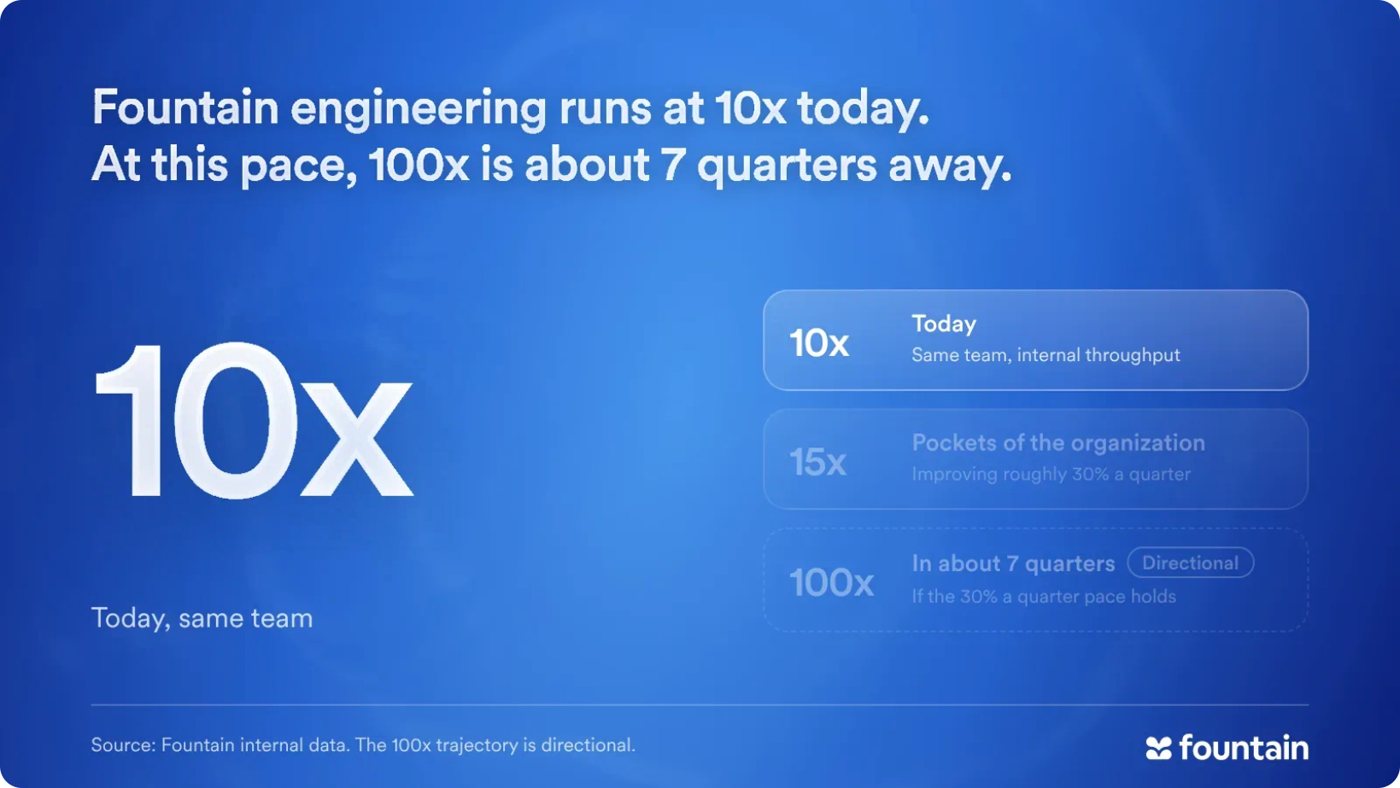
The honest way to describe what agents change is numbers. Inside Fountain, the same engineering team produces ten times the output it produced a year ago, measured on internal throughput, and pockets of the organization run at fifteen and are improving roughly 30 percent each quarter. Compound that rate and fifteen becomes one hundred in about seven quarters. Anna, our AI recruiter, already screens and interviews what a room of recruiters could, and 74 percent of applicants choose her over waiting for a scheduled call. So when I say the direction is one person doing the work of a hundred, that is a trajectory with a date on it, under two years out. Our objective is a thousand. The objective is directional. The trajectory is measured.
That multiplication creates a surplus, and the surplus has exactly two uses.
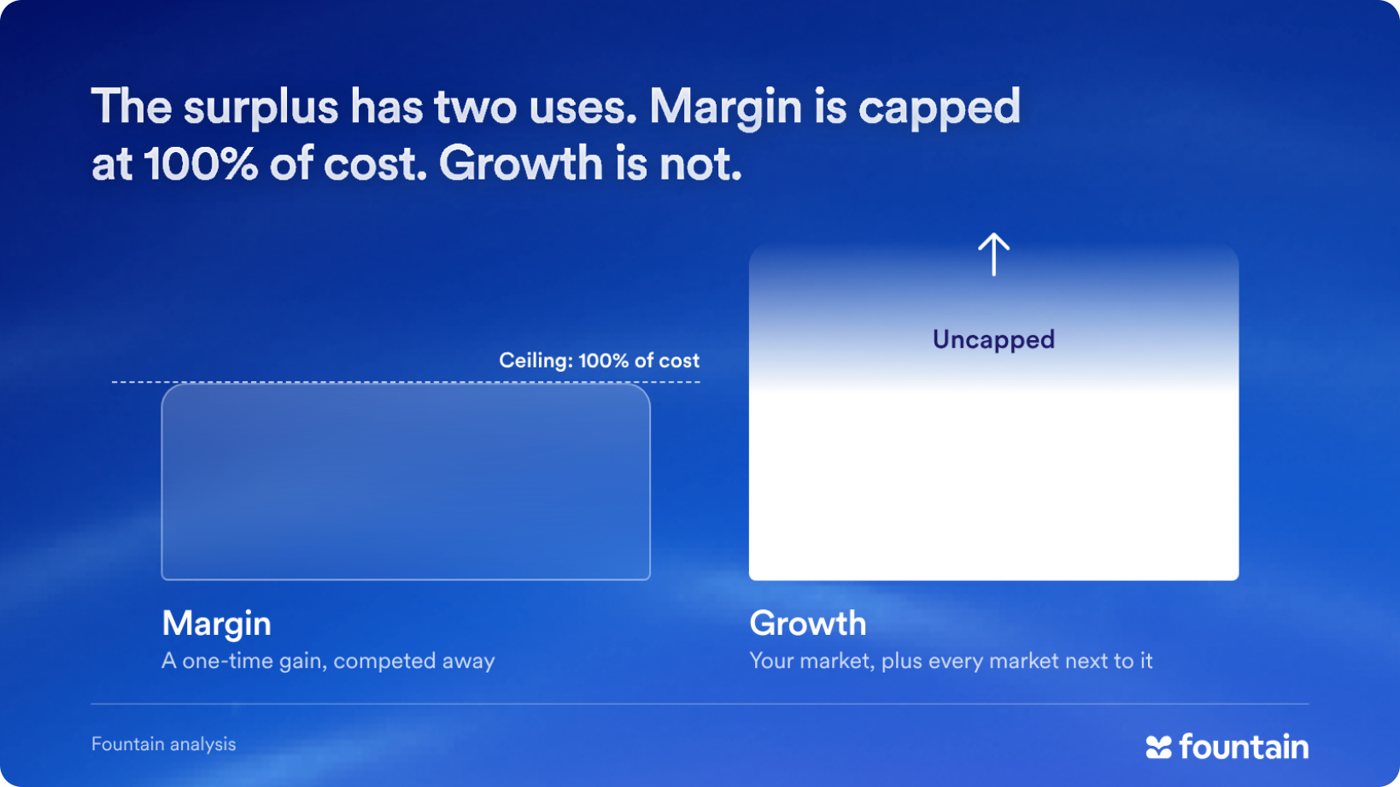
A company can cash it in as margin. Margin is capped at 100 percent of cost, and it gets competed away the moment every rival reaches the same cost floor, which they will, because everyone buys the same models. A margin advantage from agents is a one-time gain with an expiration date.
Or a company can invest the surplus in growth. Growth is uncapped: a company’s revenue ceiling is its market plus every market adjacent to it, and that ceiling sits orders of magnitude above any cost line. Companies compete on revenue over decades and on margin only between price resets.
Which brings us to the workforce question.
The tempting move, once one person can do the work of a hundred, is to keep the one and release the ninety-nine. It is also the strategic error, and the most famous agent deployment in the world just demonstrated both halves of it. Klarna’s assistant did the work of 700 agents in its first month, and the company cut its service workforce from roughly 5,000 to 3,500. Within a year, its CEO publicly admitted the cut went too deep and began rehiring humans for the work the AI could not hold. Cash the margin, cut the people, buy them back at retail. Firing converts people into a one-time margin gain that every competitor collects the same year. Keeping them is the growth strategy: each person paired with agents is a hundred-person unit, so a company that cuts ninety-nine of its hundred has cut its growth engine by ninety-nine percent. The workforce is the multiplier base.
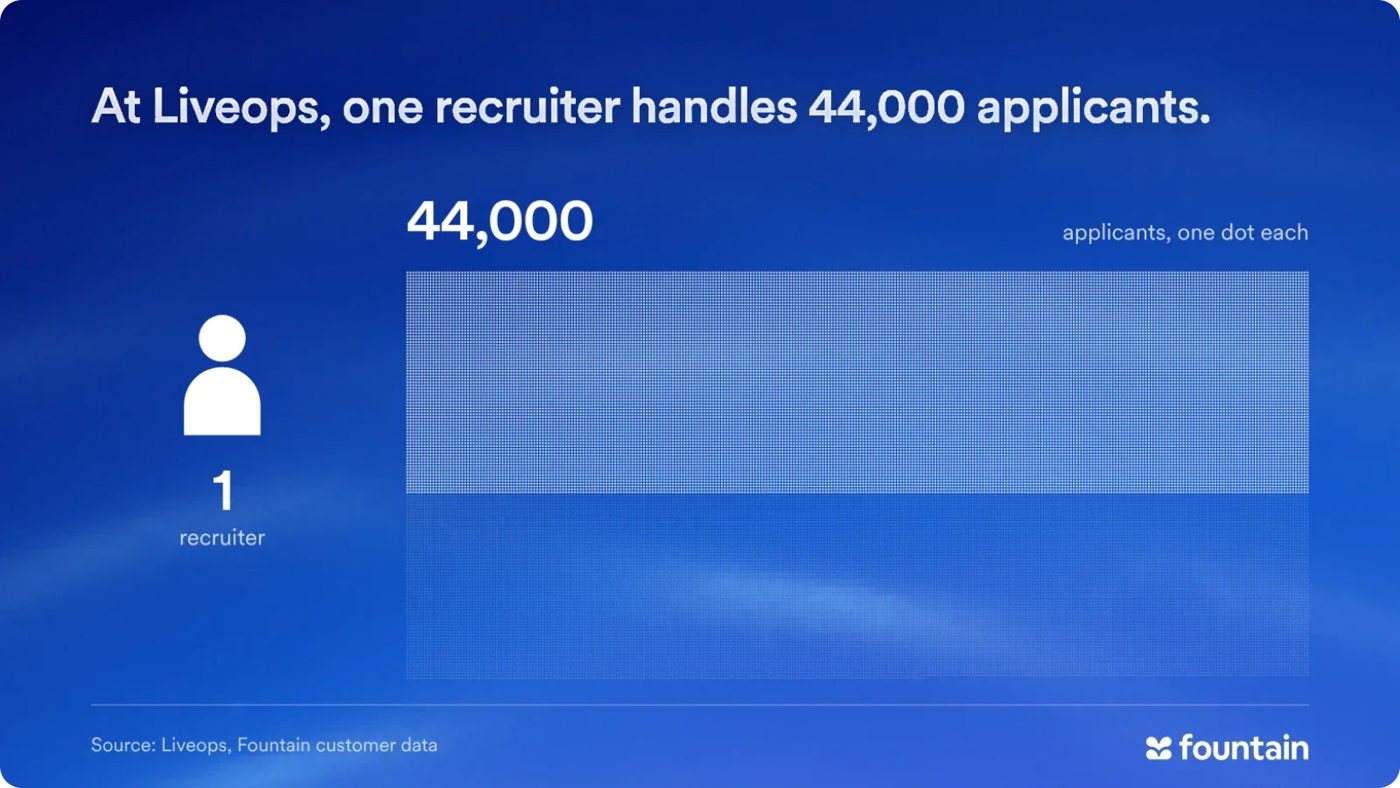
Scale is what the pairing buys. One of our staffing customers, Liveops, runs an applicant-to-recruiter ratio of 44,000 to 1. That is what one person conducting agents looks like: a ratio no amount of hiring could ever reach, held by a human whose judgment the system multiplies.
I will not pretend every role crosses the transition unchanged. Tasks move to agents, and roles built mostly from those tasks shrink. The claim holds at the level of the company, and history agrees. When ATMs arrived, they did exactly what pessimists predicted at the branch level: tellers per urban branch fell from about 21 to about 13. But a cheaper branch is a branch worth opening, so banks opened them, 43 percent more in urban areas, and total teller employment rose from roughly 500,000 in 1980 to nearly 600,000 by 2010, while 400,000 machines were installed. The teller job became relational. The pattern repeats every time execution gets cheap: humans move up to the work machines cannot do.
So what is that work?
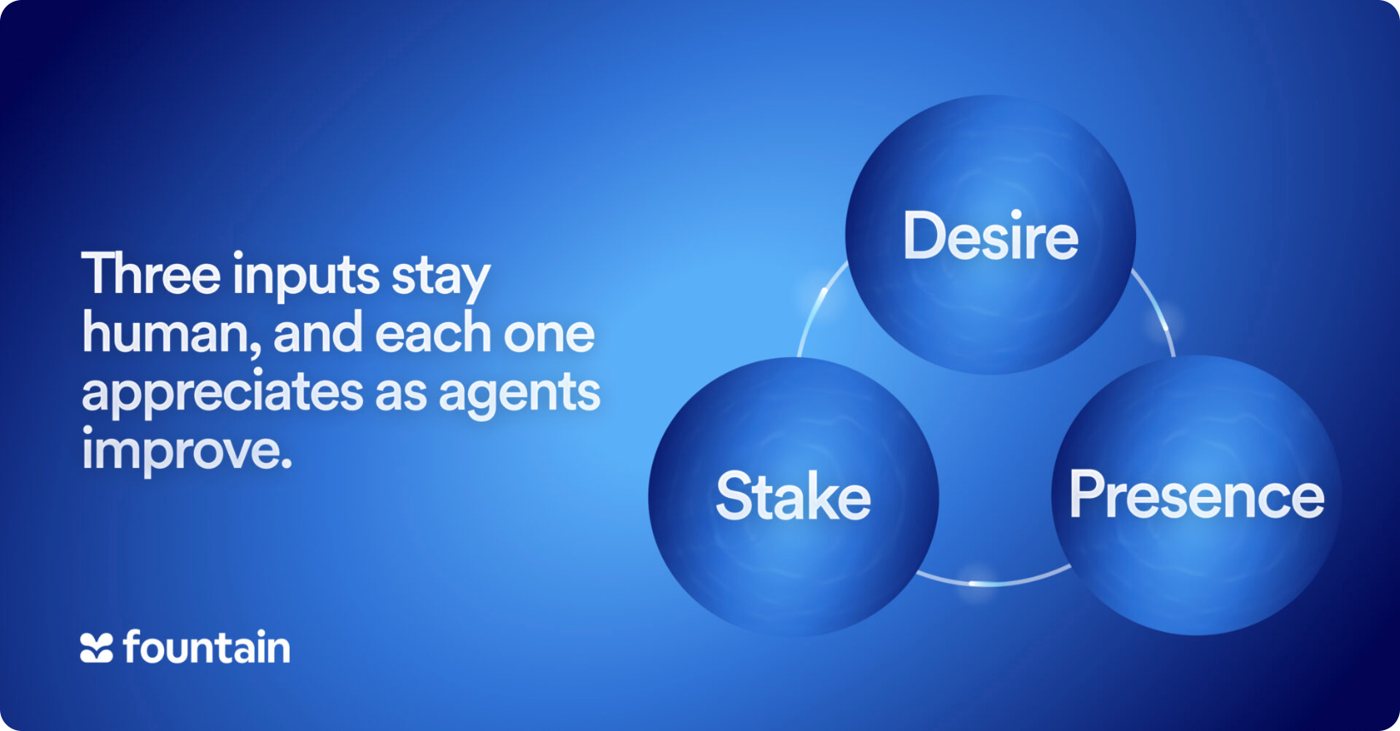
Three inputs stay human, and each one appreciates as agents improve.
Desire. Agents pursue objectives. They never set them. Every agent action traces back to a human who wanted more, better, or different, and every dollar of revenue terminates in a human wanting something, because agents do not buy. In an economy where execution is abundant, the scarce act is wanting.
Stake. Trust requires something to lose, and an agent has nothing at stake. The premium is measurable: research published in Risk Analysis found that people accept self-driving vehicles only at roughly four to five times the safety of a human driver, and half of respondents wanted the machine safer by far more. Humans get trust on credit, because a human who errs can own the error and carry the consequence. Machines pay cash, at a multiple.
Presence. An agent’s attention is infinite, which makes it free, which makes it meaningless as a signal. A human’s attention is finite, which is exactly why receiving it means something. Frontline work is presence work: care, hospitality, service, the welcome at the door. Our customers employ presence for a living, and it is the part of their operation furthest from automation.
One objection deserves a direct answer: if every company multiplies its output, who buys it all? Most work in the economy is priced out of being done at all. The audit that never runs. The candidate who never gets a call back. The question at three in the morning that never gets answered. Service levels everywhere are rationed by the cost of labor, and agents make uneconomic work economic. That undone work is the demand reservoir, and every previous wave of automation points the same way: relative share is a fight, absolute output has only ever grown.
The company that wins the agent era keeps its people, hands each of them a fleet, and points the multiplied capacity at revenue. Which changes what a job is. The person who remains is doing something new, and the new job deserves a name. That is the next chapter.
Chapter 3, From Operator to Conductor, is coming soon